Part of our field notes series from 40 nights researching European and Moroccan hospitality operators.
Key takeaways
- Restoration beats new-build for premium positioning. Three of the most-discussed new luxury hotels of the last five years — Fairmont Tazi Palace Tangier, Antiga Casa Pessoa Lisbon, and Vintage House Vila Real — are all restorations of historic buildings, not new construction.
- Architectural press is the discovery engine, not paid marketing. Antiga Casa Pessoa won the Architecture Valmor Prize 2020 and gets covered routinely in Wallpaper, Dezeen, and Architectural Digest. That press is the marketing.
- Heritage stories are defensible moats. Brand templates can be copied. A 200-year-old building with original tiles and Pierre Frey carpets cannot.
- Australian operators with credible heritage assets are systematically under-leveraging them. The opportunity is structural, not seasonal.
- Where heritage isn’t available, “place” stories work as substitutes. Regional character, indigenous heritage, and architectural era can all play the same marketing role.
A 1920s Moroccan palace, abandoned for nearly a century. A 200-year-old Lisbon apartment building. A Douro Valley wine estate. Three of the most-discussed new luxury hotels of the last five years aren’t new buildings at all — they’re restorations.
This isn’t an accident. It’s a deliberate pattern in how the world’s most sophisticated hospitality operators are positioning themselves for the next decade. And the lesson for Australian hotels — particularly those sitting on heritage assets they’re not leveraging — is significant enough that I want to spend the next 2,000 words unpacking it.
What I saw
I spent 40 nights last spring and autumn studying hospitality properties in Paris, Portugal, Morocco and Vienna. The pattern of heritage-restoration-as-luxury-positioning was unmissable. Three properties anchor the case.

Fairmont Tazi Palace Tangier
The building was commissioned in the 1920s as a palace for Mendoub Ahmed Tazi, an advisor to the king of Morocco. Construction was never completed. The structure sat abandoned for decades, slowly weathering on a hilltop overlooking the Strait of Gibraltar.
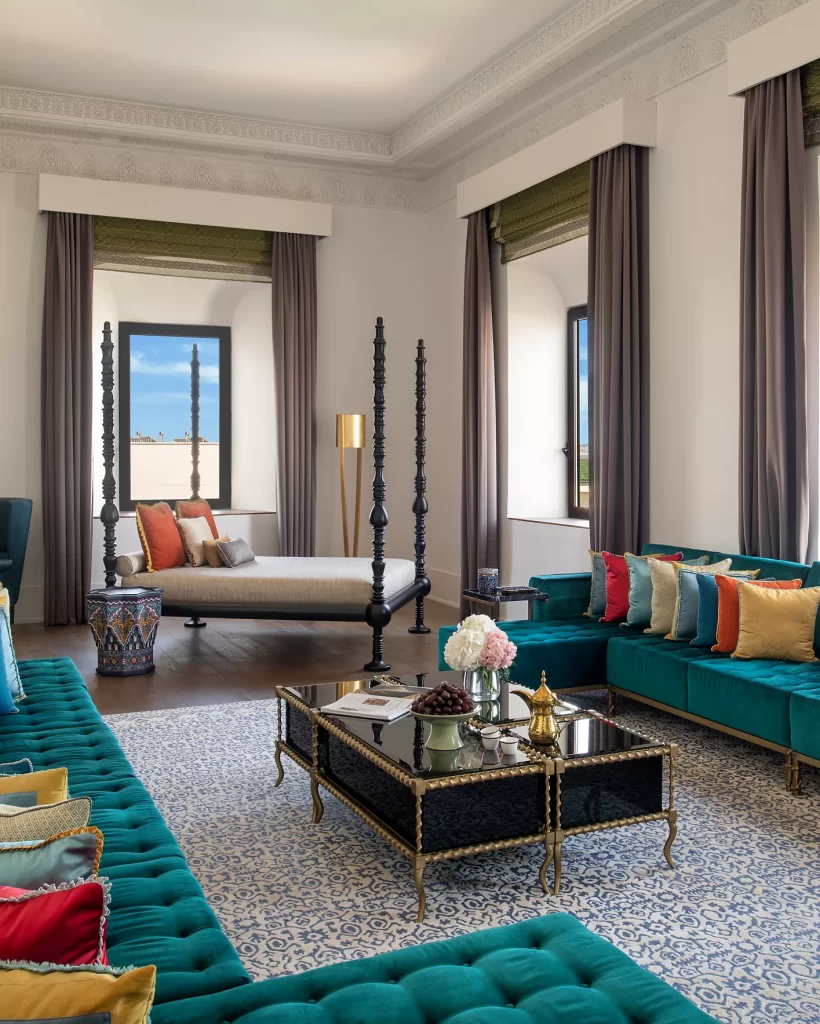
Fairmont’s restoration converted it into a 133-key luxury hotel that opened in 2021. Rates start at USD 400 per night. Travel Weekly called it “Moroccan opulence.” Architectural Digest Middle East ran a feature.
The hotel uses the building’s history as its primary marketing story. Every guest-facing touchpoint — the room signage, the spa naming convention, the menu language, the in-room print materials — references the 1920s palace lineage. The “restoration” angle is preserved in everything from the architectural detailing (Moorish geometric patterns kept intact) to the staff training (a guided heritage walk is part of the service standard).
This isn’t unusual for Fairmont — heritage palaces are core to their luxury portfolio strategy globally (Cairo’s Mena House, Banff Springs in Canada). But what’s notable is the explicit refusal to overlay a contemporary identity. The hotel is consciously preserved as a 1920s palace experience, not as a Fairmont-standard property that happens to be in an old building.
Antiga Casa Pessoa Lisbon
A different end of the heritage spectrum. Antiga Casa Pessoa is a 200-year-old apartment building in Lisbon’s Baixa district, restored by architect José Adrião.
The accolades:
- Architecture Valmor Prize 2020 (Portugal’s most prestigious architecture award)
- Gulbenkian Heritage Maria Teresa e Vasco Vilalva Honorary Mention
- Premis FAD 2021 (Iberian architecture awards)
The business model is unusual: 13 boutique apartments, each unique, sold for stays from 2 days to 1 year. Neither hotel nor pure Airbnb — it spans the leisure short-break and the remote-worker medium-stay segments simultaneously.
The marketing approach is genuinely different from most boutique hotels. There’s almost no performance marketing. Discovery is driven by:
- Architectural press coverage (Wallpaper, Dezeen, Architectural Digest, Designboom)
- Awards-circuit visibility (Valmor Prize gala, Gulbenkian Foundation ceremonies)
- Distribution via design-led platforms (Boutique Hotel collections, the property’s own website, supplemented by Airbnb/TripAdvisor/Agoda for visibility)
When I stayed in The Fountain Fresco Apartment (one of the 13 units), the original frescoes on the ceiling were preserved alongside contemporary minimalist furniture. The building’s original structural elements — exposed beams, restored tilework, frescoes uncovered during the restoration — are visible features, not decorative add-ons. The architecture is the product.
Vintage House Vila Real (Douro Valley)
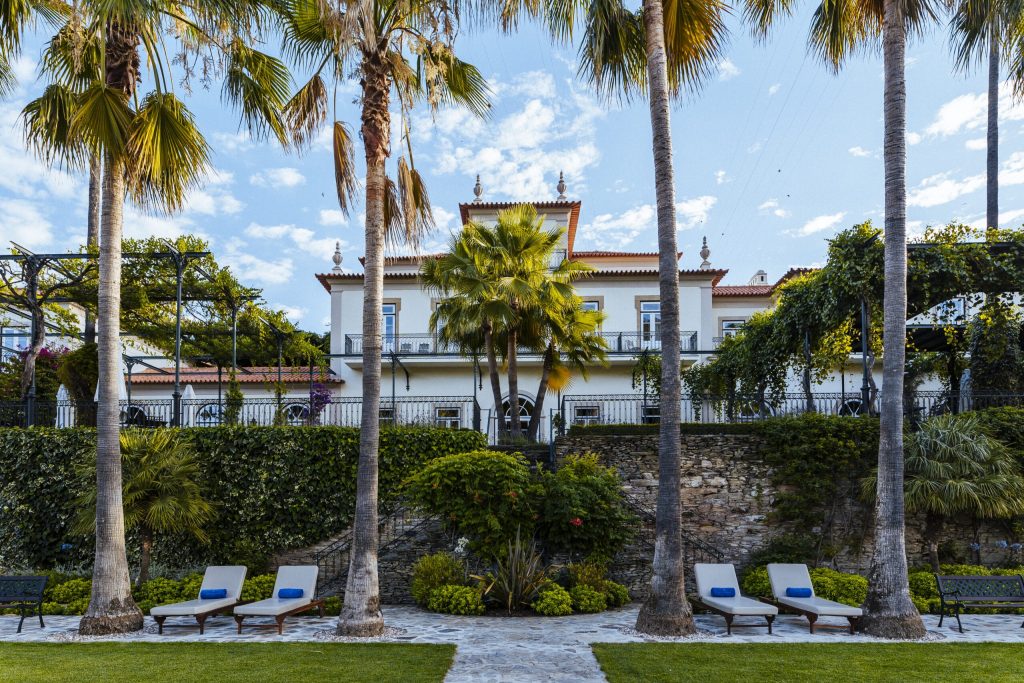
A different geography, same playbook. Vintage House Hotel is a heritage property in the Douro Valley town of Vila Real, the gateway to Portugal’s wine country.
The product is built around the building’s original character — riverside setting, traditional Portuguese stone construction, vine-covered gardens. The room rate sits in the €350-550/night range during peak season. The hotel’s marketing leans hard on the destination (Douro UNESCO World Heritage wine region) and the architectural inheritance (preserved heritage building rather than new-build resort).
This is more typical of how regional luxury hotels work in Europe — the building’s age is presented as the asset, not as the renovation burden it sometimes is on Australian heritage hotel balance sheets.
Why heritage works as a marketing strategy
The pattern across all three properties (and the broader European luxury hotel market) is consistent. Heritage works for four reasons:
1. PR and architectural press do the discovery work
Antiga Casa Pessoa’s marketing budget is almost certainly smaller than its architectural-press value. Wallpaper, Dezeen, Designboom, Architectural Digest and equivalent publications actively look for buildings to feature. They pay for original photography, write feature-length editorial, and amplify across design-focused audiences who have above-average travel spend.
For a hospitality operator, this is essentially free distribution to a high-intent audience. The cost is the original investment in the heritage restoration itself.
2. Awards circuits create defensible third-party validation
The Architecture Valmor Prize, Gulbenkian Heritage Mention, and Premis FAD aren’t marketing claims — they’re peer-recognised architectural achievements. They function as third-party validation in a category (luxury hospitality) where every operator claims excellence.
For Australian operators, the equivalent awards exist:
- Australian Institute of Architects (AIA) National Awards — most prestigious architectural awards in Australia, with hospitality projects regularly featured
- AHA (Australian Hotels Association) Awards for Excellence
- INDE.Awards — Asia-Pacific design awards with a hospitality category
- IDEA Awards (Interior Design Excellence Awards)
- Wallpaper Design Awards — international, hospitality features regularly
A coordinated submission strategy across these awards in the first 12 months after a heritage restoration is high-leverage marketing investment.
3. Heritage is operationally inimitable
Brand templates can be copied. Service standards can be trained. A heritage building cannot be replicated by a competitor. The moat is structural.
This matters strategically because most luxury hotel markets are saturated. Differentiation through service quality alone is difficult to defend (talent moves; standards drift). Differentiation through physical architecture is much more durable.
4. Heritage signals authenticity at a price point that increasingly demands it
The hospitality market segment most willing to pay for premium positioning — affluent leisure travellers aged 35-65 — is also the most fatigued by “international hotel standard” experiences. They’ve stayed at enough St Regis and Park Hyatt and Four Seasons properties to recognise the template. The premium they’ll pay for genuine local heritage is increasing, not decreasing.
Both of the Accor luxury properties I stayed at in Morocco (Fairmont Tazi Palace + Sofitel Agadir) lean explicitly into Moroccan design language. Sofitel Agadir markets itself as “inspired by the architecture of Moroccan Riads.” This is Accor — one of the world’s largest hotel groups — actively positioning its luxury portfolio through local-first design rather than brand-template-first design. It’s the direction of travel.
What it actually costs
Adaptive reuse of a heritage building isn’t cheap. The Fairmont Tazi Palace restoration was reportedly a multi-year, multi-million-dollar project. Antiga Casa Pessoa’s restoration cost is undisclosed but the project complexity (200-year-old structure, heritage-listed elements requiring preservation, contemporary fitout layered on top) implies significant capex.
Typical economics versus new-build:
The financial case for heritage restoration only works at premium positioning. For 3-star and lower-tier hotels, the math doesn’t support it. For luxury and upper-upscale, it increasingly does — particularly where the heritage building is in a desirable urban or destination location.
Four Australian heritage-asset opportunities I'd back
Based on properties I’m aware of (not exhaustive — there are dozens more):
1. Heritage country pubs in regional NSW and Victoria
Many of Australia’s heritage country pubs have under-developed accommodation product. Restoration of upper-floor rooms into boutique stays would unlock significant premium pricing against current weekday vacancy. Examples: heritage pubs in the Snowy Mountains, the Mornington Peninsula, the Yarra Valley.
2. Former government and institutional buildings
Old courthouses, post offices, banks, and customs houses that have been adaptively reused as restaurants or commercial space could in many cases support boutique-hotel conversion. The architectural character is built in; the heritage story writes itself.
3. Gold-rush era hotels in Victorian regional centres
Ballarat, Bendigo, Castlemaine, Maldon all have grand 19th-century hotels operating below their architectural potential. Investment in restoration + boutique repositioning would change their economics significantly.
4. Sydney/Brisbane/Melbourne heritage warehouses
Howard Smith Wharves Brisbane is the obvious example of warehouse precinct restoration done well. Equivalent opportunities exist along Sydney’s Walsh Bay (partially developed), Melbourne’s South Wharf, and Newcastle’s Honeysuckle district. The next generation of urban hospitality precincts will likely come from these warehouse adaptations.
What to do if you don't have a heritage building
Not every operator can buy a 1920s palace. The principle still travels.
The substitutes that work:
- Regional character — leaning hard into the unique geography, ecology, or cultural context of the location. Tiny Away cabins do this well; nature lodges generally do this well; resort properties often don’t.
- Era-specific design — committing to a single design era as the property’s identity (mid-century modern, post-war modernist, Federation, art deco). Easier than heritage restoration, cheaper than originality.
- Local creative collaborations — commissioning identifiable local architects, artists, designers, or craftspeople to anchor the property’s identity. The named-creative becomes part of the marketing story.
- Indigenous heritage acknowledgement done substantively — moving beyond Acknowledgement of Country signage to genuine partnership with Traditional Owners on design, content, and storytelling. This is both ethical practice and competitive differentiation.
The audit question to ask yourself
If you operate a hospitality property in Australia, the question worth asking this quarter is:
“What is the most differentiated story embedded in our physical property, and are we leading our marketing with it?”
If the honest answer is “we lead with our brand standards and amenity list,” there’s likely opportunity to test a more heritage-led or place-led positioning. The international luxury portfolio is moving in this direction — Accor explicitly, smaller boutique groups instinctively. Australian operators with the assets to compete here are advantaged when they choose to.
If you’d like to talk through what that audit looks like for your specific property, we run a 30-minute hospitality positioning call — no obligation, useful regardless of whether we end up working together.
What's next in this series
- Spoke 2 — The L’Atelier de l’Entrecôte playbook: how a 65-year-old single-menu restaurant out-earns its multi-cuisine neighbours
- Spoke 3 — The Moroccan riad concierge model: what Australian short-stay operators can learn from Pierre at Riad Dar Beija
Back to the pillar: 40 Nights, 23 Properties — Field Notes
About the author
Eugene Went is the Digital Marketing Director at Merge, a hospitality-specialist marketing agency based in Brisbane. Merge works with Accor portfolio properties, boutique hotels, precinct operators, alternative-stay providers, and restaurants across Australia.
Images courtesy of Fairmont Hotels / Accor, Antiga Casa Pessoa, and Vintage House Hotel.