Part of our field notes series from 40 nights researching European and Moroccan hospitality operators.
Key takeaways
- L’Atelier de l’Entrecôte serves one main dish. Green walnut salad, sirloin steak with secret sauce, matchstick fries. Same menu since 1959.
- No reservations. Daily queues. €26.50 per cover. The format prints money because operational complexity is minimised and throughput is maximised.
- The “secret sauce” is proprietary IP and the central marketing asset — recipe guarded across three generations.
- The family has expanded to multiple Paris brands plus Geneva and international franchises without diluting the formula.
- Australia has very few single-menu restaurants at this scale. Lune (croissants) is the proof. Multiple precinct slots are sitting empty for an operator who’d run a single-dish format with discipline.
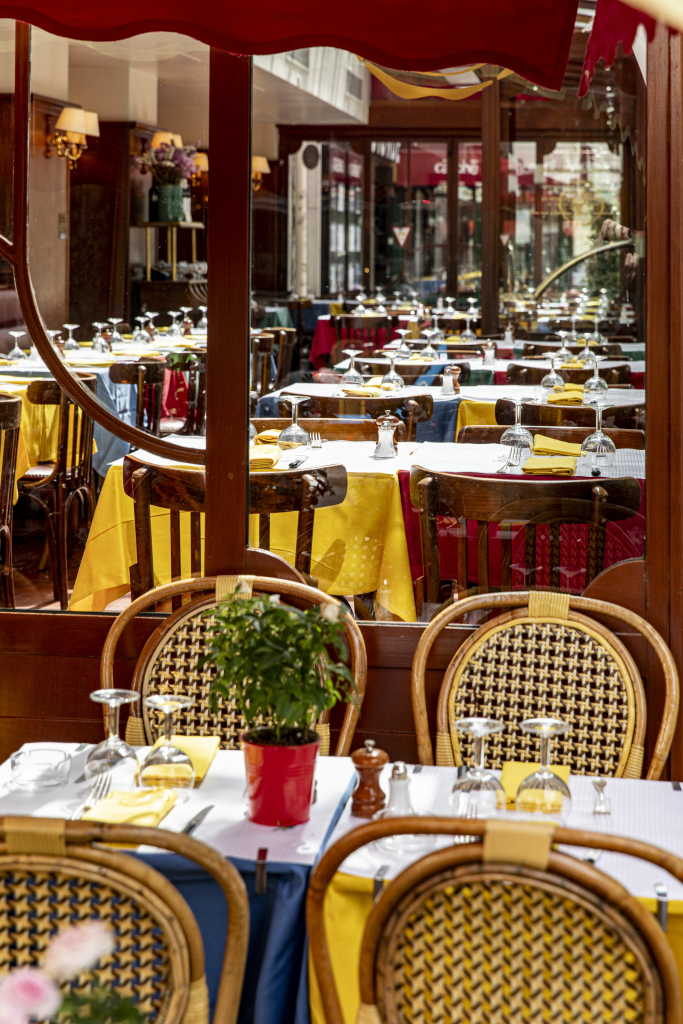
I queued for L’Atelier de l’Entrecôte on Rue Marbeuf in Paris on a Thursday night in September 2025. The line was 25 deep at 7:25pm. By 7:35 it had become a sit-down restaurant with two-table turnover before I’d finished my walnut salad.
The menu hasn’t changed since 1959. There isn’t a menu, really. Every guest gets the same sequence:
- Green salad with walnuts (served on arrival)
- Pre-sliced sirloin steak cooked to your requested doneness, topped with the “secret sauce”, served with matchstick fries
- A second service of hot fries, mid-meal
- Dessert — the only real choice on the menu
That’s it. €26.50 for the menu. No reservations. Lines daily at 11:30am and 7pm in any weather, at every original location.
The model is so well-honed, so structurally repeatable, and so beautifully simple that I want to spend this article unpacking exactly why it works — and why there’s a missing Australian version of it in basically every metropolitan hospitality precinct in the country.
The origin story
The concept starts in 1959 at Porte Maillot in Paris. Paul Gineste de Saurs, a winegrower from Gaillac in southwest France, wanted to diversify his income beyond the vineyard. He took over a lease in Paris near Porte Maillot and opened Le Relais de Venise – Son Entrecôte.
Two decisions shaped everything that followed:
- A single main dish — steak, matchstick fries, walnut salad, secret sauce. Affordable for the broad Parisian middle class.
- No menu card — every guest gets the same formula. The only choices are steak doneness and dessert.
Gineste de Saurs wasn’t a trained restaurateur. The single-dish model was originally an operational simplification strategy — easy to execute, low kitchen complexity, easy purchasing, easy training. The brand-equity outcome was incidental at first.
Sixty-six years later, the family has expanded into a small ecosystem of related brands all using the same formula:
- Le Relais de Venise – Son Entrecôte — the original Porte Maillot site, still operating
- Relais de l’Entrecôte — the daughter Marie-Paule’s expansion brand, multiple Paris locations plus Geneva and international franchises
- L’Entrecôte — provincial group (Toulouse, Bordeaux, Lyon) operated by other family members
You can walk into any of them and get the same meal at the same price within €2-3. The execution is essentially identical.

Why the single-menu model works operationally
Most restaurants treat their menu as a marketing surface and a guest-experience tool. The L’Entrecôte family treats it as an operational liability that’s been mostly eliminated.
Consider the implications of zero menu choice for the back-of-house:
Kitchen line simplification
A typical Parisian bistro kitchen prep list includes 30-50 SKUs across protein, produce, dairy, sauces, breads, garnishes, and dessert. The L’Entrecôte kitchen prep list is roughly:
- Sirloin steak (single cut, pre-portioned)
- Matchstick fries (single cut, twice-cooked)
- Walnut salad mise en place
- “Secret sauce” (mise en place + assembly)
- Dessert components (limited menu)
The entire kitchen is built around one dish. Mise en place is faster. Waste is lower. Staff training is simpler. Consistency is dramatically easier. A new kitchen hire reaches full productivity in days rather than weeks.
Order-taking complexity reduced to two questions
Servers ask one question on arrival (“how do you want your steak — saignant, à point, bien cuit?”) and one mid-meal (“dessert?”). That’s it. Order errors collapse. Service training time collapses. Cover-to-cover service speed accelerates.
Throughput dynamics
Tables turn fast. The two-stage fries service is a hospitality detail that doubles as a throughput optimisation — by serving fries in two waves, the kitchen keeps the kitchen-to-table cycle moving without holding plates. Average cover time at the original Relais de Venise is roughly 55-65 minutes. A two-cover-per-table-per-service night is achievable.
Pricing model and ticket size
Recent published menu price: €26.50 for salad + entrecôte + secret sauce + two services of fries. The L’Entrecôte provincial group cites €19 for a single dish with unlimited fries. Add a dessert (~€7-9) and a beverage (€6-12), and the average ticket sits at €25-35 per cover including drinks.
For comparison, the typical multi-cuisine Parisian bistro average cover sits in the €35-50 range. L’Atelier earns less per cover but vastly more per square metre per night because of throughput.
The "secret sauce" as proprietary IP
The sauce is the brand’s central marketing asset.
It’s described in marketing materials as “famous secret sauce.” Creamy, herbal, slightly tangy. Central to the food experience. The recipe has never been officially published and is reportedly guarded across three generations of the Gineste de Saurs family.
In 2007, Le Monde published a “finally revealed” version describing chicken livers, fresh thyme, cream, Dijon mustard, and butter blended and reduced. The family did not confirm or deny. Fans argue published recipes approximate the taste but aren’t identical. The mystery is the marketing.
From a business standpoint, this is proprietary product IP performing the function of a brand. It’s both impossible to fully copy and impossible to forget. Competitors can serve steak frites. They can’t serve this steak frites with this sauce.
For Australian operators thinking about their own format, the equivalent question is: what’s the irreplicable element of your concept that someone three doors down can’t replicate by next month?
Why no reservations is a strategy, not a flaw
Most restaurants treat reservations as table-management table-stakes. L’Entrecôte treats no reservations as a deliberate brand choice.
The mechanics:
- Queues are visible from the street, twice a day, every day
- The queue itself becomes a demand-evidence advertisement — passersby see crowds wanting to eat there
- “We don’t take reservations” reinforces the “we don’t need to” implication — you come on our terms
- Walk-in only also avoids no-shows and the cancellation friction that bedevils reservation-dependent restaurants
The boulevard Pereire site sees queues forming at 11:30am and 7pm sharp. They’re so consistent that locals time their arrivals to be first in the queue, not to avoid it.
For an Australian operator, the equivalent question: is there a tenant slot or a concept opportunity where the no-reservations + queue-as-marketing approach would work? It requires a few specific conditions:
- Genuinely high demand (a queue must form or the format dies)
- A walkable precinct or street where the visible queue creates the demand-evidence loop
- A team comfortable with the operational implications (front-of-house has to handle walk-in flow)
- A format that supports rapid table turn (single-menu + two-question service makes this dramatically easier)
The expansion pattern: why the formula travels
By the 2000s, the Gineste de Saurs family had expanded into a small portfolio of related brands using essentially the same formula. Le Relais de Venise stayed at the original Porte Maillot. Relais de l’Entrecôte (Marie-Paule’s brand) opened multiple Paris locations plus Geneva, then franchised internationally — Middle East, Latin America. L’Entrecôte in the south of France (Toulouse, Bordeaux, Lyon) is operated by other family members.
What’s notable is what they didn’t do:
- They didn’t add a second main dish in any of the new locations
- They didn’t reduce the menu to “the steak frites concept” generically — they kept the salad, the secret sauce, the two-stage fries, the dessert simplicity
- They didn’t significantly adjust pricing across locations (within reason)
- They didn’t dilute the model to capture different segments
The discipline is what makes the formula export. Most restaurant brands lose what makes them special when they scale — they add a salad option to capture vegetarians, a fish dish to widen appeal, a kids menu to capture families. Each addition adds operational complexity and dilutes the brand promise. L’Entrecôte’s brand promise is the same one dish, the same way, every time. That’s what travels.
For Australian multi-location operators, the temptation to add complexity to new locations is constant. The L’Entrecôte case is the counterargument: the most enduring restaurant brands often hold the format more rigidly than the founders expected to.
What an Australian L'Atelier could look like
The genre matters less than the discipline. Single-dish concepts work in any cuisine — what matters is the operational commitment.
Some candidate concepts that would work in Australian metropolitan precincts:
1. Steak frites — direct L'Entrecôte translation
The closest direct copy. Single steak cut, one sauce signature, two-stage fries, walnut salad. Pricing AUD 35-40 for the menu. Reservations unavailable.
2. Single-bowl ramen
Tokyo’s most successful ramen operators (Ichiran, Ippudo’s smaller-format venues, regional chains like Ramen Tatsunoya) often run essentially single-bowl concepts. Australian metropolitan precincts have ramen options but few with the no-menu single-bowl discipline.
3. Bánh mì-only Vietnamese
Fast, repeatable, walkable. One signature bánh mì done very well. No pho, no rice plates, no spring rolls. Pricing AUD 12-15 per cover but throughput approaching 400-600 covers per day in the right precinct.
4. Oyster bar — single-presentation oyster
A dozen oysters one way, with one signature mignonette. Add a champagne pour. Done. Manly Wharf, Howard Smith Wharves, Sydney Fish Market all have positions for this concept.
5. Single-format dessert
Lune in Melbourne has proven this works for croissants. Equivalent positions exist for single-format gelato (Roman tradition), single-format crêpes (Breton-style), single-format Portuguese tarts (Pastéis de Belém scale).
The pattern across all of these: the operator’s job is to refuse to expand the menu when the market asks them to. Every successful single-menu operator has had multiple inflection points where they could have added the second dish. They didn’t. That’s the playbook.
What this means for hospitality precinct operators
If you operate a hospitality precinct (HSW, Manly Wharf, Eat Street Northshore, South Bank, James Street, equivalent in any Australian capital), the L’Entrecôte case has a specific application: there’s likely a tenant slot in your precinct that should be single-menu.
Most precincts curate tenant mix for cuisine variety (Italian, Asian, Mexican, modern Australian, etc.). Few curate for format diversity (multi-menu, single-menu, fast-casual, fine dining, walk-in only, reservation only). Adding single-menu high-throughput operators to the mix changes the precinct’s economics:
- Foot traffic increase — visible queues attract foot traffic that benefits surrounding venues
- Day-part diversification — single-menu operators often do lunch dramatically better than full-service neighbours
- Different customer segment — quick lunch market that may not be served by the rest of the tenant mix
- Per-square-metre revenue uplift — single-menu operators often pay better rents because their throughput justifies it
The next time a tenant slot turns over in your precinct, the question to ask isn’t only “what cuisine is missing?” but also “what format is missing?“
The audit question
If you operate a restaurant in Australia, the question worth asking this quarter is:
“If we removed every menu item except one, which one would survive — and could we build the whole operation around it?”
For most operators, the answer will be “no, the business needs the menu breadth.” For some — particularly newer operators with a strong signature dish — the answer is “actually yes, and we’d probably do better.” If you’re in the second camp, the L’Entrecôte playbook is a 65-year-old proof of concept worth studying.
If you’d like to talk through what a single-menu format could look like for your precinct or restaurant, we run a 30-minute hospitality strategy call.
What's next in this series
- Spoke 3 — The Moroccan riad concierge model: what Australian short-stay operators can learn from Pierre at Riad Dar Beija
- Spoke 4 — Luxury glamping economics: why nature-stay operators leave money on the table
Back to the pillar: 40 Nights, 23 Properties — Field Notes
About the author
Eugene Went is the Digital Marketing Director at Merge, a hospitality-specialist marketing agency based in Brisbane. Merge works with restaurants, F&B precincts, and hospitality groups across Australia.
Images courtesy of Le Relais de l’Entrecôte.