Part of our field notes series from 40 nights researching European and Moroccan hospitality operators.
Key takeaways
- The room is the loss leader. The experiences are the margin. Top luxury glamping operators capture 60-70% of their revenue from transfers, F&B, and activities — not the bed-night.
- Bundled multi-night packages out-earn accommodation-only by 2-3x per guest. Sahara desert camps proved the math.
- Hybrid models (B&B base + paid add-ons) capture more incremental revenue per stay than either pure all-inclusive or pure accommodation-only.
- Australian alternative-stay operators (Tiny Away, Unyoked, Wander Cabins, etc.) mostly sell accommodation-only and are systematically leaving the experience-layer margin on the table.
- “Eco” positioning needs specific operational claims to defend the premium — generic claims become a liability.
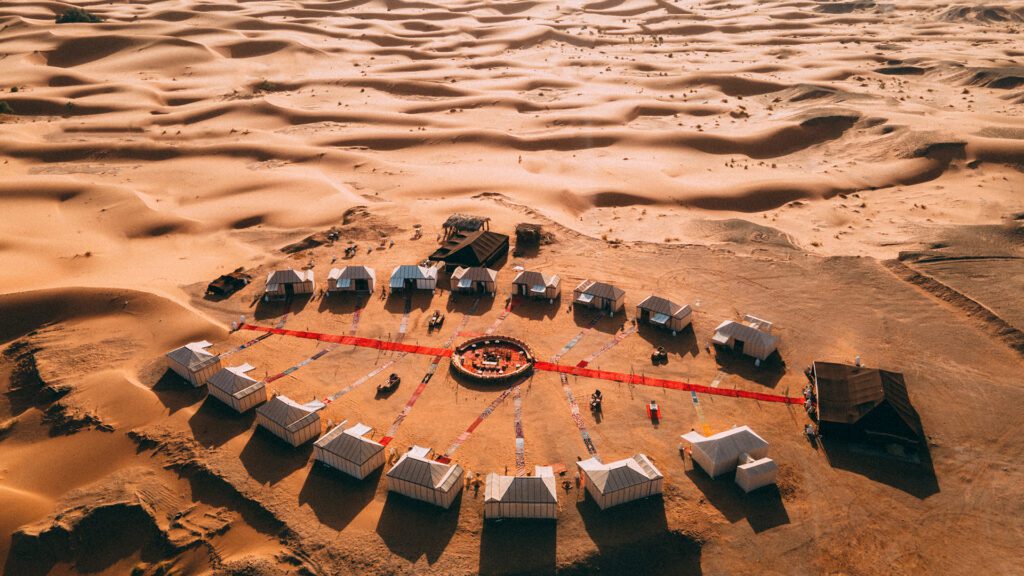
A 2-night stay at Desert Luxury Camp in the Sahara’s Erg Chebbi dunes invoiced at AUD 1,766 for two people. The canvas tent itself was probably 30-40% of that price. The rest was a masterclass in how nature/eco operators turn accommodation into a bundled experience product.
I spent five days across three Moroccan nature/eco properties last October as part of a longer research trip:
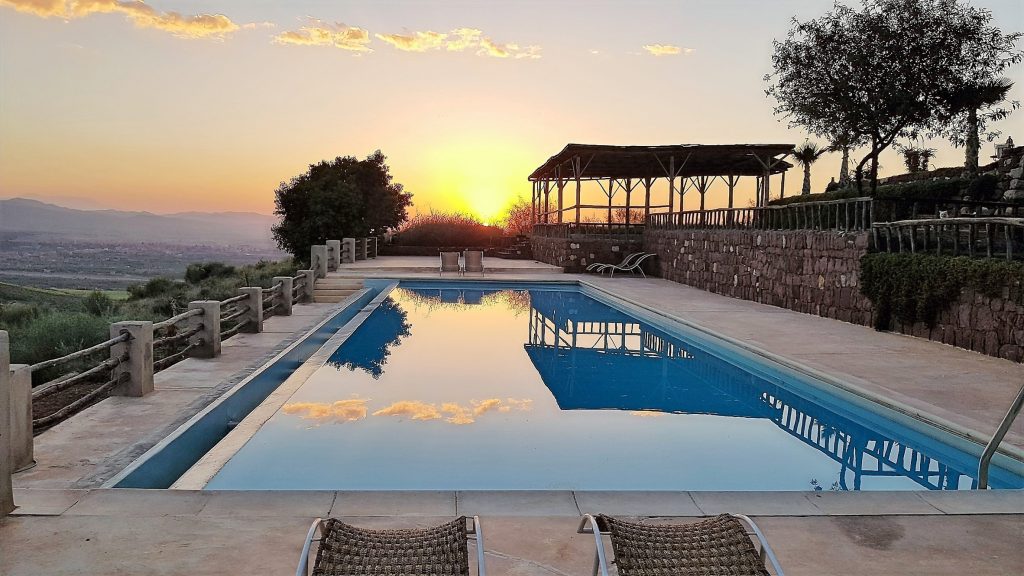
- Le Douar Berbère in the Ourika Valley (Atlas Mountains ecolodge, 5 suites, adults-only, Swiss-managed)
- The O Experience Tayourt Lodge in Imsouane (Atlantic coast surf lodge, 6 rooms, beachfront)
- Desert Luxury Camp in the Sahara’s Erg Chebbi (luxury glamping)
What I saw was a structural revenue model that Australian alternative-stay operators are largely not adopting. Here’s why that matters.
The Desert Luxury Camp invoice breakdown
Let me start with the cleanest example. Desert Luxury Camp sent an itemised invoice (#8878) for my 2-night stay:
Total: MAD 10,400 (~AUD 1,766) for two people, two nights.
Let me reverse-engineer this from a hospitality operator’s perspective:
- Direct accommodation cost (depreciation on tent, linen, utilities, cleaning labour): probably AUD 80-120 per tent per night
- F&B cost of goods (breakfast + dinner for 2 guests × 2 days): probably AUD 80-100
- Camel + guide for 2 hours: probably AUD 30-50 (camel-owner partnership rate)
- 4WD excursion + driver: probably AUD 80-120 (vehicle + driver day-rate share)
- Transfers: probably AUD 40-60
- Sand boards, campfire, music, welcome drink: low marginal cost, maybe AUD 20-30
Total direct costs: ~AUD 350-480 for 2 guests over 2 nights.
Gross margin: AUD 1,766 – AUD 480 (high estimate) = ~AUD 1,286. That’s a 73% gross margin on the entire stay.
Compare that to a typical Australian glamping operator selling accommodation-only at AUD 350/night for 2 nights:
- Revenue: AUD 700
- Direct costs (similar to above, minus F&B and activities): ~AUD 200
- Gross margin: AUD 500 (~71% on the bed-night)
The percentages are similar. But the absolute gross margin is 2.5x higher in the bundled model. Same guest, same number of nights, dramatically more revenue captured per stay because the operator monetises the entire vertical, not just the bed.
Why the room becomes the loss leader
Once you understand the bundle math, the strategic positioning of the room shifts. The room becomes the anchor product that justifies the stay, but it’s no longer the revenue centrepiece.
The implications cascade:
1. Pricing on the room can be more aggressive
If the bundle captures most of the margin, the operator can be price-competitive on the headline accommodation rate to drive bookings. This makes the property more discoverable on OTAs (better positioning in price-filtered search results) without sacrificing per-stay revenue.
2. The activity calendar becomes the marketing centrepiece
Desert Luxury Camp’s website and social presence lead with the experiences, not the tent product. Camel rides, sandboarding, 4WD trips, traditional music — these are the visually-shareable content moments. The tent appears in supporting imagery but isn’t the headline.
For an Australian operator, this implies the marketing centrepiece shifts from “look at our beautiful cabin” to “look at the weekend you’ll have.” Same property, different framing, different conversion economics.
3. Operational complexity moves from accommodation to activities
The operator’s day-to-day complexity shifts from housekeeping logistics to activity coordination. This is a different operational muscle — vendor management, scheduling, partner relationships, vehicle/equipment maintenance. For operators currently running clean accommodation operations, building activity operations is the harder part of the model. Worth getting right.
4. The customer relationship deepens through the stay
A guest who’s done a camel ride, a sandboarding session, and a 4WD excursion with the camp has had multiple high-engagement experiences with the property. They leave with stronger emotional connection, better photos, and more memorable stories than a guest who slept in a tent for 2 nights and ate breakfast.
This shows up in repeat bookings, referrals, and online review quality. The review economics alone tend to justify the model — bundled-experience properties consistently outperform accommodation-only properties on review scores in the same segment.
The B&B + add-ons hybrid: Le Douar Berbère's model
The full all-inclusive bundle isn’t the only path. Le Douar Berbère in the Ourika Valley runs a different version: B&B base rate with paid add-ons.
The structure:
- Base rate: €144-159/night (~AUD 240-265) for the suite, including breakfast
- Paid add-ons available during stay:
– Hammam treatment (~EUR 45-60) – Spa massage (~EUR 60-90) – Cooking class (~EUR 50) – Yoga sessions (~EUR 20-30) – Archery activity (~EUR 25) – Bike rental and bike tours (~EUR 15-25 per day) – Horseback riding (~EUR 50) – 4WD excursions to surrounding sites (~EUR 80-150) – Dinner at the on-site restaurant (~EUR 40-60 per person)
Most guests buy 3-5 add-ons during a 2-3 night stay. The incremental revenue per stay is typically EUR 200-400 per couple on top of the room rate.
This model is structurally easier for Australian operators to test than the full all-inclusive bundle, because:
- It doesn’t require partner-vendor coordination if the activities are in-house (cooking class with the chef, yoga with a contracted instructor, etc.)
- It’s lower commitment for guests — they pay for what they want, not a forced bundle
- It exposes which experiences actually have demand — you can measure attach rates per add-on and iterate
The economics aren’t quite as strong as full bundling (you don’t capture as many add-ons per stay because there’s no default-on assumption), but the operational complexity is significantly lower.
The lifestyle-brand-layer model: The O Experience
The third Moroccan property I studied, The O Experience Tayourt Lodge in Imsouane, runs yet another variation: accommodation + adjacent lifestyle brand.
- The lodge itself is sold on Booking.com and direct
- A separately branded surf school (O Surf Club) operates adjacent to the lodge
- Yoga classes are offered through the lodge
- Surf lessons + board rental go through the O Surf Club brand
Guests can stay at the lodge without doing any surfing or yoga. But the lifestyle brand layer means the lodge’s identity is “the place where surfers stay” rather than “a beachfront guesthouse.” This positioning attracts the surf-and-lifestyle traveller segment specifically — a higher-spend, more engaged, more brand-loyal segment than generic beach travellers.
The lesson is that the experience layer doesn’t have to be operated by the accommodation operator. A trusted partner brand layered adjacent to the property captures similar segment-positioning value with less operational complexity.
For an Australian operator, this could look like:
- A nature cabin operator partnering with a local guided-hike company under a co-branded experience name
- A wine-country accommodation partnering with a vineyard tour operator
- A surf-coast cabin partnering with a surf school
The operator doesn’t have to run the partner business — they just have to brand the relationship clearly enough that guests choose the property because of the experience association.
Why "eco" positioning needs specific operational claims
One related observation from the three Moroccan properties: their sustainability claims vary dramatically in specificity, and the specificity matters commercially.
Le Douar Berbère publishes specific operational facts:
- Solar-powered (“designed for self-sufficiency”)
- Own well for water supply
- Built with traditional clay, stone, and wood — Amazigh building methods that reduce embodied energy and provide passive thermal performance
- Embedded in a traditional Berber village, supporting local employment
The O Experience describes “bioclimatic / biomimicry design principles” and “local materials.”
Desert Luxury Camp is less eco-coded — leans “luxury glamping” rather than “eco” because in the Sahara, solar power and water management are operational baseline, not branding assets.
What this teaches: eco positioning works to justify premium pricing when the claims are specific and verifiable. Generic “eco-friendly” claims become a liability when consumers (or worse, regulators) start interrogating them.
For Australian alternative-stay operators with sustainability positioning, the audit question is whether your claims are:
- Specific (“powered by 6kW rooftop solar; water from a 10,000L rainwater tank treated to drinking standard”)
- Quantified (“our typical 2-night stay generates 8kg of CO2 emissions vs the ~80kg of a comparable hotel stay including transport”)
- Operationally visible to guests during their stay (visible solar panels, in-room water info card, etc.)
If your claims are “low-impact” and “eco-friendly” without numbers behind them, the claims are doing less work for you than they could. Worse, they’re brittle if challenged.
What an Australian operator should test in the next 90 days
Concrete pilot suggestions, ranked by effort:
Low-effort: B&B + add-ons (1 month build)
If you currently sell accommodation-only, add 3-5 paid add-ons that can be coordinated with minimal new operational complexity:
- Pre-stocked grocery hamper (markup 30-50% on goods + convenience premium)
- Local-experience partnerships (winery tour, farm visit, spa treatment) with 15-25% referral
- Late checkout (12pm or 1pm) for AUD 30-50
- Private breakfast hamper delivered to the cabin/room
- Equipment rental (bikes, kayaks, etc.) if locally relevant
Build forms (Google Forms or similar) for guests to pre-book these. Send them in the pre-stay email (see the Moroccan riad concierge model article). Track attach rates.
Medium-effort: Bundled weekend package (3 months pilot)
Build a bundled product for the most popular stay length (typically 2 nights):
- 2-night accommodation
- Round-trip transfer from a major nearby city (Sydney, Melbourne, Brisbane, etc.)
- Welcome hamper on arrival (local cheese, wine, breakfast basics)
- One partner experience included (winery visit, hike, spa treatment)
- Sometimes one meal included
Price the bundle at 1.5x accommodation-only. Distribute via Airbnb Experiences + direct. Measure conversion and gross margin against your current accommodation-only revenue per stay.
Higher-effort: Adjacent lifestyle brand layer (6-12 months)
Build or partner with a lifestyle brand that becomes the property’s positioning layer:
- A guided experience operator who exclusively departs from your property
- A wellness program (yoga retreats, meditation weekends) co-hosted with a partner
- A creative residency program (artist-in-residence, writer-in-residence)
This is multi-quarter work but the segment-positioning value is the most significant of the three options.
The big-picture audit question
If you operate any kind of nature, alternative, or experience-driven accommodation in Australia, the question worth asking this quarter is:
“What percentage of our total revenue per stay comes from the bed-night vs. everything else? And what would it take to shift that ratio?”
Most Australian alternative-stay operators are at 95%+ bed-night revenue. The Moroccan models I studied are at 30-60% bed-night, 40-70% everything else. The gap is real, the math is favourable, and the path to get there is well-trodden by international operators willing to share what works.
If you’d like to talk through what bundling, hybrid, or lifestyle-brand-layer models could look like for your specific property, we run a 30-minute hospitality strategy call.
What's next in this series
- Spoke 5 — European precinct activation: how Marrakesh, Lisbon and Tangier maintain late-night dwell time
Back to the pillar: 40 Nights, 23 Properties — Field Notes
About the author
Eugene Went is the Digital Marketing Director at Merge, a hospitality-specialist marketing agency based in Brisbane. Merge works with alternative-stay operators, nature lodges, and boutique hospitality groups across Australia.
Images courtesy of Desert Luxury Camp and Le Douar Berbère.